
Won't the real Rohit Sharma please stand up?
He has evolved his T20 batting over the past three years, and his 38-ball 78 against KKR was a manifesto on his future

To be “vintage” is a double-edged sword: implicit in the compliment is a hint that you might be past your prime.
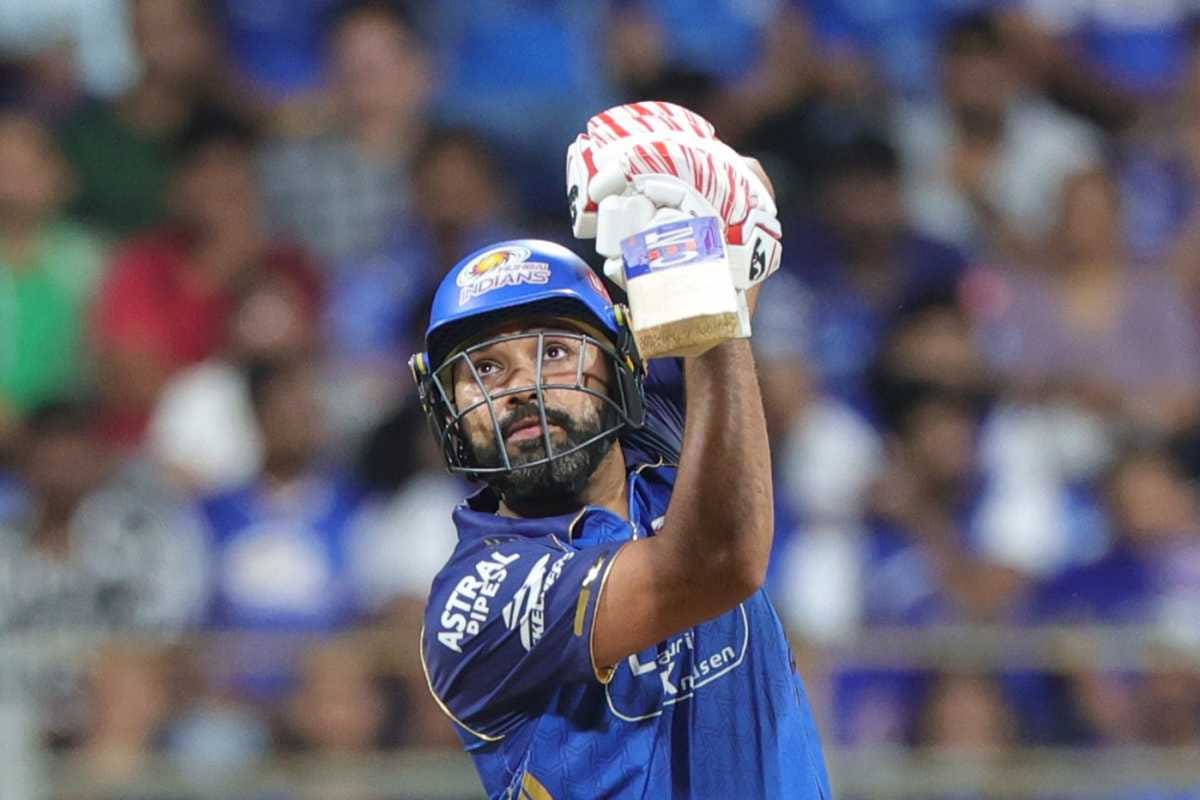
On Sunday, Rohit Sharma was as vintage as he’s ever been. He had that extra second to his game in the middle. You know, when he has a psychic ability to read the bowler’s mind. What other explanation is there, to explain how he knows where the ball is about to land, and how he is halfway through his shot by the time it reaches him? Against Kolkata Knight Riders - on a pitch where the ball retained both its pace and bounce - the game only seemed to slow down for Rohit.
Foot forward, or a slight shuffle backward. Tilt your bat just enough. Swing through the arc. End result: a thrash through the covers, or a loft over deep midwicket. A half-century, for the first time ever, within the powerplay of the IPL. Off just 23 balls, his quickest in the tournament too.
And all the while through the heavy metal batting, he slowed down: in the moments between bat meeting ball. The Wankhede has a capacity of only 40,000-odd spectators, but it is one of the loudest in the country, especially when the MI juggernaut gets going. Still, there is always a drop in the noise when a bowler runs in: worlds away from the tennis-themed silence during a rally, but just enough for the surge that comes after to be even more noticeable.
The crowds love Rohit. They always have. On Sunday, they hushed up just a little each time he was at the crease and about to hit a ball. Even before he has, if you’ve ever seen vintage Rohit, you know where it’s going.
Each time Rohit smacked his six fours, and six sixes, the Wankhede crowd found their voice, then a few more decibels. He compiled his 78 off just 38 balls, and effectively wrenched the match away from KKR’s grasp before he stepped off the field after a mishit towards the on-side in the 12th over.
MI might have been chasing 221, but they already had 148 of them. He’d snatched the game away from KKR before even they might have realised it.
Really, ask anyone in the crowd who watched the knock: this was vintage Rohit.
Where does the prime lie for Rohit Sharma, the IPL batter? He has breached the 500-run mark just once - back in 2013, when he stepped in as the Mumbai Indians captain midway through the season to guide them to their first title. His runs came at a strike rate of 131.54, though. He has been, for the majority of his T20 career, an anchor at the top of the order.
Year after year, especially since MI’s last title win in 2020, he was slipping down the averages table even as his strike rate remained stagnant. Really, “vintage” Rohit is more about how he bats rather than the specifics of his numbers. Yet, it is worth nothing that as pitches around the country have gotten flatter - and the Impact Player rule has inflated run rates - Rohit has almost morphed into a different batter while staying true to his technique.
Minimal footwork, big swings, solid grounded shots. There’s been one big change: the latter has disappeared almost completely as a first-choice weapon from his T20 game.
The impetus for this change was twofold around 2024, when Rohit 2.0 began emerging: he had led India to another disappointing exit in the T20 World Cup, and he also found the MI captaincy wrenched away from him. Playing as an Impact Player across two seasons, he elevated his strike rate (from 132.8 in 2023) to 150 in 2024 and 149.28 in 2025. In between, he won India a T20 World Cup and retired from the format.
On Sunday, he went at 205.26. This wasn’t the Rohit of old. Yet, you must remember how he batted: that extra second, the timing, the trademark pulls off his hips peppered throughout the innings.
Unwrap his postmodern T20 intent, fostered over the past three years, and surely deep within was vintage Rohit.
He only plays ODIs for India now, and has spent the hiatuses in between international series to regain some of the fitness that had evidently deserted him at the nadir of his career: when he dropped himself from the Test team at the end of 2024, during the tour of Australia, after a wretched run of form.
His hairline has receded further and the beard has grown in thicker, but he has almost slimmed down to the Rohit that first took up MI captaincy in 2013. Still, that era - with its innings-long Rohit knocks, almost ambient middle overs to put on in the background, and the subtle gold rims on the MI jersey - have long disappeared for the unsubtle.
The middle overs are a place for acceleration, a theory Rohit put to the test by going even more heavy metal before his luck ran out after his umpteenth swipe across the line. MI’s jerseys have evolved more and more towards golden stripes crisscrossing all across the map. T20 cricket as a whole has evolved into a brutal sport: watch Rohit’s replacement in the India team, Abhishek Sharma, and you’ll see a side-stepper who runs down the leg side because he has customised his game to muscular six-hitting.
Rohit Sharma stays still at the crease more often than not, but he is still the OG big-hitter: he has 205 of them in T20Is, the most in the format. Yet, vintage Rohit has had to put his intent at the front and centre of his T20 game to survive in it. For most of his T20 career, he simply stayed in long enough to hit all his sixes. Now, he hits his sixes first and worries about staying in later, if ever.
The evidence on Sunday showed he can still carve out a space for himself as T20 cricket evolves past his generation of batters. Is he past his prime? Perhaps: vintage Rohit is the one we might still associate with the 20-year-old who set the stage alight at the 2007 T20 World Cup; or maybe, with the one who shifted to open for India and collected three double centuries in one-day cricket; or maybe, even with the rollicking Test knocks he played in a late-career surge.
Rohit Sharma has been around for a long time. What has stayed common throughout, though, is the extra second he has when he is on top of his game. Foot forward, or a slight shuffle backward. Tilt your bat just enough. Swing through the arc. End result: a thrash through the covers, or a loft over deep midwicket.
It has been well over a decade since he crossed the 500-run landmark in an IPL season. Each successive year since relinquishing captaincy, he has looked more likely to get there. If he does so this time around, you might look at his methods and ask: could the real Rohit Sharma please stand up?
And then, as anyone who’s ever watched him bat will tell you: Why, here, it’s been vintage Rohit all along.